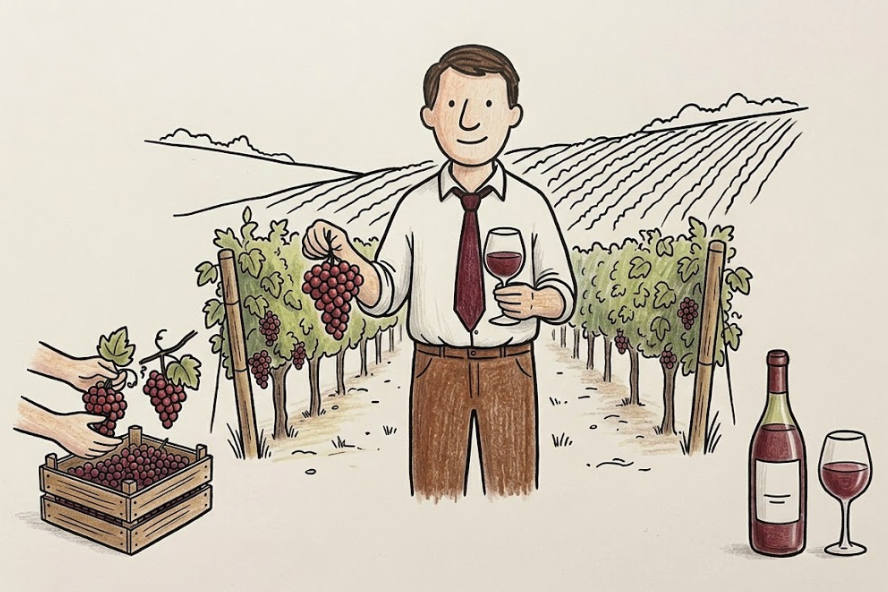
Stories · Natural wine
What is natural wine? How it differs from organic, how it tastes, and how to choose
Natural wine brings healthy grapes and a place to the glass with as little added intervention as possible. It is not the same as an organic label or a no-sulfite claim. How you buy and store it decides whether the bottle arrives intact.
What this article covers
Natural wine is a name for wine made from healthy grapes grown organically or biodynamically, fermented without selected cultured yeast or added extras, and with human intervention kept to a minimum.
Organic wine is mainly a legal standard for how the grapes are grown. Natural wine also asks the cellar to stay out of the way: fewer additives, less filtration.
Sulfur dioxide is either not added at all (sans soufre) or added only in a very small dose at bottling. Fermentation itself produces a trace of sulfite, so even an unadded wine is not chemically zero.
Many bottles skip fine filtration and fining. What remains is the place, the grape’s own fruit, and a savory, broth-like texture.
With little protection, the wine is sensitive to heat. Keep it out of a warm room, store it cool and dark, and buy from an importer or shop that controls temperature all the way to you.
What natural wine is
Natural wine is wine made from healthy grapes grown without chemical pesticides or fertilizers, then fermented with as little added material and as little technical force as possible. Natural wine, vin nature, and the casual Japanese shorthand “nature” point to the same idea.
For a long time the industry used cultured yeast, aroma enzymes, generous sulfite, and fine filters so the same taste could be repeated anywhere. In the 1970s and 1980s, Jules Chauvet and Marcel Lapierre in Beaujolais pushed back, asking the grape and the place to show themselves instead. That is the root of today’s natural-wine movement.
It is a way of working, not a fashion label. The grower bottles honestly, without extra makeup. What you taste is closer to the fruit and the land.
How it differs from organic, biodynamic, and no-sulfite wine
Shelves mix the words organic, bio, natural, and no added sulfite. They do not cover the same thing.
Natural wine starts in an organic or biodynamic vineyard, then ferments with wild yeast and almost no additives or technical force. Sulfite is omitted or added only in a tiny dose at bottling. A few public schemes exist, including Vin Méthode Nature, but the core is a practice, not a logo.
Organic wine is a legal growing standard: no synthetic pesticides, herbicides, or fertilizers. Cultured yeast and approved cellar additions are still allowed, including sulfite within a legal cap. Marks include the EU leaf and Japan’s organic JAS.
Biodynamic wine follows Rudolf Steiner’s 1924 farming calendar and preparations. The cellar is expected to stay close to the land, and sulfite caps are strict. Demeter and Biodyvin are the usual certifications.
A “no added sulfite” label only says sulfite was not added. The grapes may still come from conventional farming, and the wine may still be fined and filtered like an industrial product. That is not the same as respect from vineyard to bottle.
An organic mark certifies the vineyard, not a natural cellar. A certified organic wine can still be adjusted, yeasted, and filtered.
Three cellar habits that set it apart
What separates natural wine is the cellar, not only the vineyard. Conventional winemaking steers the wine toward a repeatable taste. Natural wine trusts the fruit and keeps the hand light.
First, wild yeast. Most wines are seeded with a cultured strain so fermentation is fast and the aroma predictable. Natural wine uses only the yeasts on the skins and in the cellar. Several species take turns, so the work is slower, and the aroma is less uniform.
Second, almost no additions. Chaptalization, acid adjustment, enzymes, and tannin powder may be legal. These growers skip them. That only works if the fruit was already sound, which means careful hands in the vineyard.
Third, little or no filtration or fining. Fresh wine is cloudy with yeast and pulp. Egg white, bentonite, and fine filters make it bright, and also strip flavor. Natural wine often waits for gravity, then bottles unfiltered or only roughly settled. Sediment is leftover extract, not a fault.
Why sulfite is almost never absolute zero
As yeast ferments grape juice, it makes a small amount of sulfite on its own, often cited around 5 to 15 mg/L. A sans soufre wine, with nothing added by hand, can still show a trace in the lab.
Sulfite slows oxidation and checks spoilage bacteria. Some careful growers add a very small dose just before bottling so the wine survives a long trip. Vin Méthode Nature allows a bottled wine to carry no more than 30 mg/L total sulfite in its low-sulfite mark, a fraction of a conventional dose.
Zero added sulfite is not the only honest choice. The first duty is to send the place to the table still sound.
How it tastes, and the hangover myth
The surprise is the lack of industrial smoothness. What drinkers call a broth-like savor comes from fruit that was not pushed by cultured-yeast perfume, and from extract that filtration did not strip away. Grape, mineral, and wild fermentation sit together, and the finish feels soft rather than sharp.
The glass changes in air. Day two or day three can be rounder than the first pour. That is part of drinking a living wine.
“No sulfite means no hangover” mixes a feeling with a myth. The main cause of a hangover is alcohol and acetaldehyde. Natural wine is still typically 11 to 14 percent alcohol. Drink too much and the next morning arrives anyway.
Some people do feel clearer. Those sensitive to sulfite may avoid a scratchy throat. Without added sugar corrections or aroma enzymes, the drink can feel less tiring. The pace is often slower, with water alongside. None of that cancels the alcohol.
It is not a magic bottle. Drink it as a farm product, in a modest amount. Alcohol is illegal under 20 in Japan. Drinking in pregnancy or while nursing can harm a child.
Official marks, and growers without them
For years people said natural wine had no legal definition. Public and private schemes are now filling some of that gap.
In France, Vin Méthode Nature began formal use in 2020 with INAO’s cooperation. The rules include organic or biodynamic certification, 100 percent hand harvest, wild yeast only, no oenological additives, and no reverse osmosis, flash pasteurization, or fine filtration. Sulfite is marked either as none added, or as no more than 30 mg/L total at bottling.
Italy’s ViniVeri sets its own cellar limits, including a dry-wine SO2 cap of 80 mg/L. RAW WINE, founded by Master of Wine Isabelle Legeron, publishes farming and sulfite figures for the wines it shows.
No logo does not mean the wine is not natural. Many small family estates have farmed and bottled this way for decades and skip the paperwork. A mark is a shortcut. The grower’s land and habits tell you more.
How to keep it, and how to drink it
Little sulfite and little filtration mean the bottle notices heat and shock more than a conventional wine.
Heat and sudden swings are the enemy. Leftover yeast can referment, push the cork, and leak or oxidize the wine. A cellar at 12 to 16°C and above 60 percent humidity is ideal. Without one, a refrigerator vegetable drawer is the next best place. The main fridge, around 2 to 5°C, often shuts the wine down. The drawer, around 6 to 8°C, is gentler. Wrap the bottle in paper so cold air, light, and vibration land softer. Avoid a summer room, a stove, and a sunny window.
After shipping, let it stand three days to a week before opening. Sediment settles, and the taste often comes back into balance.
Too cold, and fruit and savor hide. Start whites and orange wines near 10 to 12°C, reds near 14 to 16°C. A struck-match or boiled-egg smell at the first pour is often reduction, not ruin. Swirl a large glass, or wait half an hour. Day two and day three can be the better pours.
How to choose without a miss
The range is wide, and acidity or cloudiness can surprise a first glass. Three checks help.
Temperature on the way to you matters most. A low-sulfite wine that cooks in a hot container or warehouse does not recover. Buy from an importer or shop that uses a refrigerated reefer and keeps the cold chain at home.
The back label is a clue. Vin Méthode Nature is the French natural-method mark. Sans soufre means no sulfite added by hand. Non filtré means bottled without fine filtration. A pretty drawing is not enough. Look for who farmed it, and where.
A few hectares, weeded and sorted by hand, hold more of the person than a factory vineyard. Choose the place, the work, and a shop that can tell you both.
Questions people ask
How long after opening? With the cork back on, in a fridge or cellar, three days to a week is often still good. Day two or three can be rounder than the first pour.
Is the sediment safe? Yes. It is yeast, polyphenol, and tartrate left because the wine was not finely filtered. It is part of the body.
A sulfur or egg smell at opening is usually reduction, not spoilage. Air clears it. Swirl, or wait half an hour.
Is orange wine the same thing? No. Orange wine is a style: white grapes fermented on their skins. Natural growers often make it, but an industrial orange wine also exists.
No cellar? Use the vegetable drawer, wrapped in paper. Do not leave the bottle in a warm room.
A glass that still holds the work
Natural wine is not a passing slogan. It is a way of farming and bottling so the soil and the grape reach the glass without being flattened by additives.
Organic sets a growing standard. Biodynamics looks for a rhythm with the year. Natural wine carries that honesty into the cellar. In the bottle are that season’s sun and rain, and the person who stayed in the rows.
You may meet a little cloud, or a startling first smell. Treat them as the face of that year, not as a defect to throw away.
In Japan, alcohol is for adults 20 and over. Drink modestly.