Stories · Georgia · Qvevri
One hundred eighty-five qvevri in a cliff. Queen Tamar’s wine at Vardzia and the cup that toasted victory at Shamkor, 1195
As Seljuk armies pressed from the south, George III and Queen Tamar carved Vardzia into the cliff, a cave city with 185 qvevri in its marani, wine as sacred sustenance under siege. Barefoot at prayer, then victory at Shamkor in 1195.
A cliff outside, one hundred eighty-five jars within
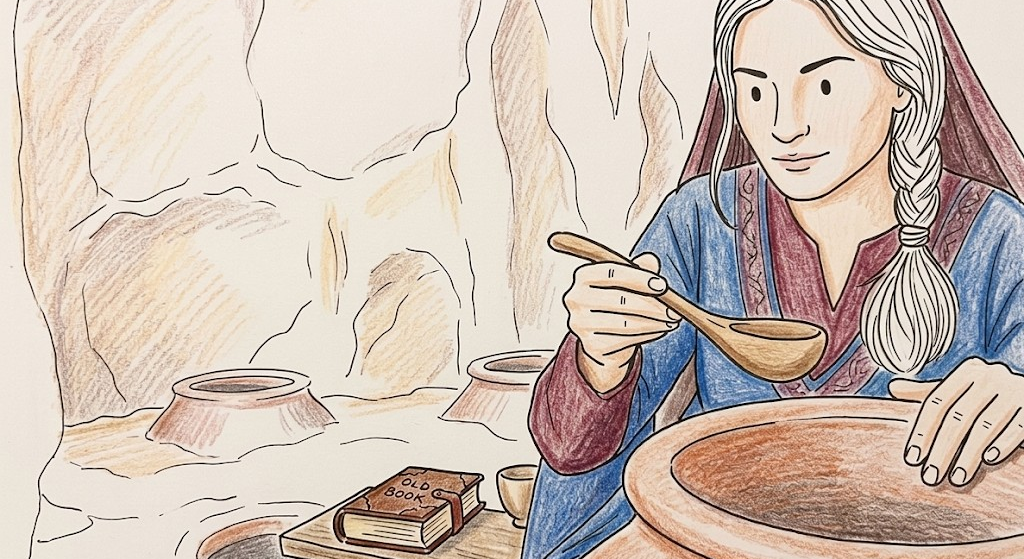
On the Mtkvari River in southern Georgia. Vardzia looks from outside like nothing but cliff. Inside it is a city, thirteen levels of chambers, chapels, water channels, and rock-cut marani woven through the stone.
Begun under George III around 1156 and expanded by Queen Tamar in the 1180s against Seljuk pressure, excavations have found some twenty-five wine cellars and more than 185 qvevri sunk into the floors.
Springs, irrigation, and cool cellars were meant to sustain thousands through siege. Wine was not luxury alone, sanitized drink, morale, and for the faithful the blood of Christ in clay.
Invasion vs wine in the rock
The enemy of Georgia’s golden twelfth century pressed from the south, above all the Eldiguzid Atabegs of Azerbaijan. Frontal sieges bleed armies dry; Vardzia was built to be invisible.
Monks farmed terraces, fermented in buried qvevri, and aged wine in stable cave air. Even among Georgia’s ancient winemaking line, Vardzia’s marani fuse faith, war, and agriculture.
The 1283 earthquake stripped the cliff face and exposed the honeycomb within. Rows of qvevri still overwhelm visitors, wine etched here as the bond that held a people together.
Barefoot prayer: June 1, 1195
In 1195 the Eldiguzid Atabeg Abu Bakr marched on Georgia. At Shamkor, modern Shamkir, Azerbaijan, the kingdom faced a war it could not afford to lose.
Tamar mobilized the realm and appointed her husband David Soslan commander. Church tradition holds that she went barefoot to Metekhi Church in Tbilisi and knelt before the Theotokos until word of victory arrived.
On the field Soslan’s flanking maneuver routed the enemy. Spoils included banners later donated to monasteries. One queen at prayer, one general at the sword, cups binding before and after, the human center of the story.
Feasts, exile, and the first husband
Behind victory, court supras flowed with wine, and politics. Tamar’s first husband, Yuri Bogolyubsky from Rus, drank and ruled badly; she divorced and exiled him.
Twice he rebelled; twice her nobles crushed him. Golden-age splendor hid cups that could ignite a coup.
Treasurer and poet Shota Rustaveli dedicated The Knight in the Panther’s Skin to Tamar. Later legend whispers forbidden love; the poem itself, friendship, loyalty, praise of wine, remains Georgia’s secular scripture.
From Gelati to UNESCO
Monasteries Tamar protected, above all Gelati, anchored medieval learning and winemaking alongside Vardzia. That golden age feeds the lineage of qvevri practice today.
In 2013 UNESCO inscribed Georgia’s traditional qvevri winemaking as Intangible Cultural Heritage. Tamar’s reign shines as one of the brightest pages in an eight-thousand-year story.
The glass in your hand today
Wine ladled in Vardzia’s caves and wine buried in Kakheti’s qvevri share one philosophy: earth-fired clay, time underground. Modern Saperavi reds and amber Rkatsiteli carry a land that outlasted invasion and prayer.
When you tilt a Georgian glass, you may taste one hundred eighty-five jars in a cliff, a barefoot queen, and the toast before Shamkor. UNESCO called it living heritage in 2013, a cup you can still drink.