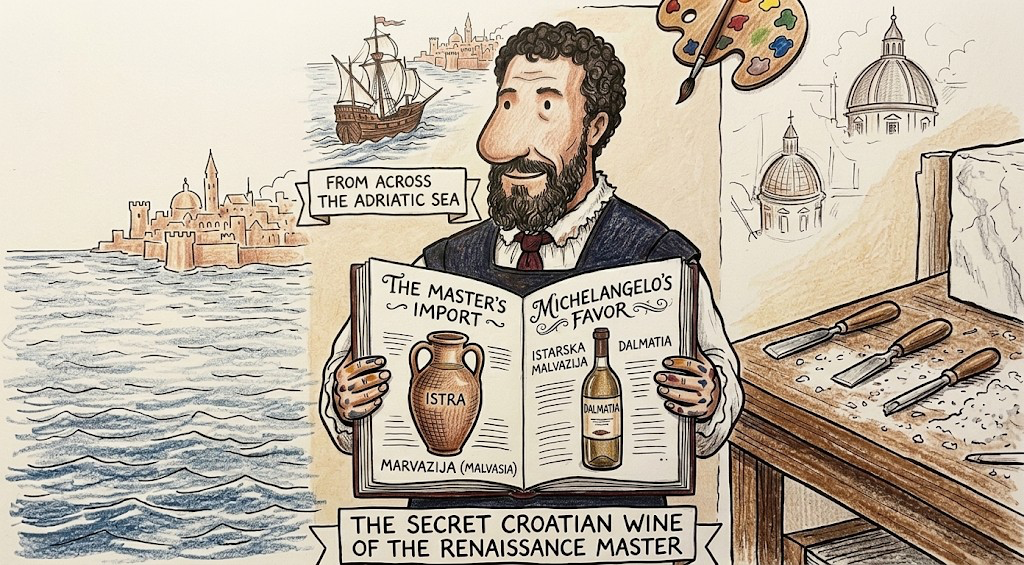
Stories · Croatia · Malvasia
On the Sistine scaffold, Michelangelo’s healing white was not Tuscan. Adriatic Malvasia still lives in today’s Istrian glass
Indifferent to food, Michelangelo cared about the quality of wine that restored him. The premium whites of Florence and Rome often came across the Adriatic via Venice. That line lives on as Istarska Malvazija.
The master’s white was not the local table wine
While painting the Sistine ceiling, the white wine that steadied Michelangelo Buonarroti was not a local Tuscan or Roman table wine. It was a premium import that had crossed the Adriatic.
His letters and household accounts (Spese) suggest he was plain about everyday food, yet exacting about the quality of wine that eased fatigue. He stood on scaffolding of his own design, head tilted back for hours, paint dripping onto his face, neck and eyes worn for years. The cup was closer to necessity than luxury.
A worn body vs Venetian-route white
Two pressures framed the story. One was creative labor that wore the body down. The other was local Tuscan wine still young, sharp, and everyday.
The Adriatic was a Venetian sea lane. Istria and the Dalmatian coast, under Venice’s rule or influence, shipped wine to the Italian mainland. Malvasia whites grown in sun and salt air were denser in fruit, higher in alcohol, and sturdy enough for long voyages. In Florence and Rome they traded as premium imports.
Renaissance medicine also spoke of mineral, acidic wine as a warming “medicine” for a chilled and depleted body. For a man like Michelangelo, Adriatic white arriving through merchant and literary routes was both pleasure and recovery.
Paint dust and salt in the glass
Picture him standing on his own scaffold, neck arched back toward the vault, paint dust in the eyes, a sparse meal, and a white that is not sparse. Peach and apricot fruit, a hint of salt on the throat, acidity that lingers. Adriatic air, drunk in Rome.
The master may never have named a vineyard in the Spese. What the records do show is spending and insistence on better white. Much of what counted as “fine” white in those cities came from across the sea via Venice. That fact links Michelangelo’s cup to the Adriatic.
Landing in Istarska Malvazija
That line survives in Croatia today as Istarska Malvazija. Red Istrian soil (crljenica) yields peach-and-apricot aroma, a faint Adriatic salt, and easy acidity.
The glass in your hand carries the same sea wind that restored a Renaissance master between hours on the ceiling. Not as trivia, but as temperature and salt.