Stories · Canary Islands · American Revolution
America’s revolution was paid in Canary wine, not gold, smuggling, forged papers, and Robert Morris
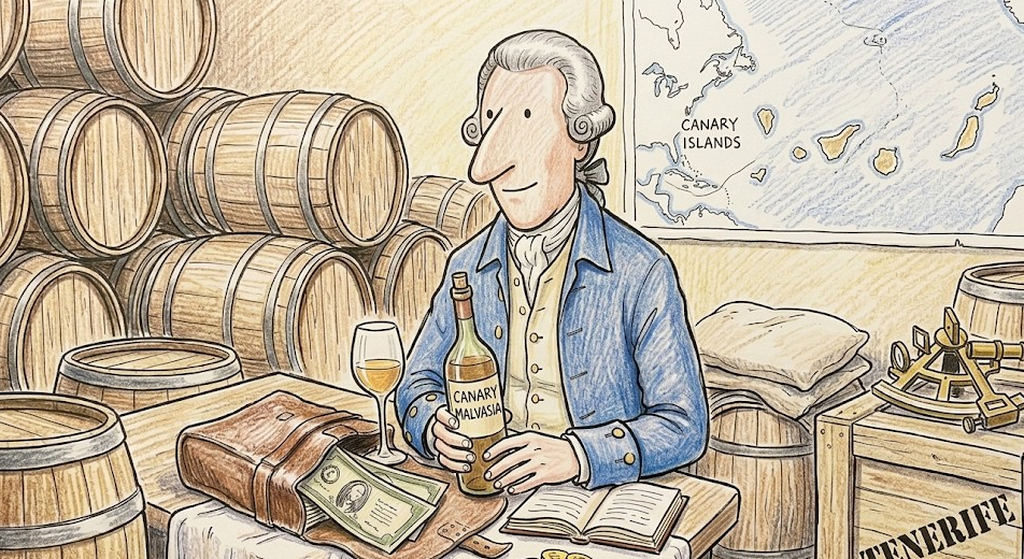
When Continental paper money collapsed, Canary Malvasia crossed the Atlantic as liquid currency, smuggled past the blockade to buy guns, powder, and blankets.
A nation without gold fought with wine
In 1783, America won independence. Textbooks speak of liberty and ideals. On the ground, the finance officers faced something grittier.
There was almost no hard money. Continental paper collapsed until the phrase “not worth a Continental” entered the language. Soldiers were paid in scraps of paper. Arms dealers refused it.
Yet the army still bought guns, powder, blankets, and boots from France and the Netherlands. One answer was wine from the Canaries, especially sweet Malvasia: slow to spoil, easy to resell, a liquid form of gold.
Blockade vs the back door
The enemy was the Royal Navy’s Atlantic blockade. Sending wine straight from Tenerife to the American coast was nearly suicide. For the rebels, Canary wine was currency before it was a drink.
Island traders and North American merchants stepped in. Irish trading houses such as the Colgans in Tenerife, and on the mainland Robert Morris, who routed cargo through detours instead of frontal runs.
Wine landed first at free ports like Dutch St. Eustatius in the Caribbean. Papers were altered: “sugar,” “Dutch cargo.” Then small boats slipped into Chesapeake inlets under cover of night.
Sometimes British officers themselves bought Canary wine as a luxury, and looked the other way at the next inspection. The war was often decided by ledgers and moonlit coves, not broadside salvos alone.
Why wine, not gold
The thirteen colonies lacked trusted specie. Paper issues collapsed; merchants refused what they could not spend.
Canary wine, above all sweet Malvasia, was a prestige good that traveled well: high alcohol, slow spoilage, sometimes gaining value at sea.
To French and Dutch arms dealers, Continental notes were worthless paper. A cask of top Canary wine could be turned into cash in any noble or merchant house. The barrel was a wallet.
Robert Morris and the frozen valley
At the center stood Robert Morris, Founding Father, Superintendent of Finance, and one of the largest private traders of his day.
Through networks that included the Colgans, Morris moved Canary wine and tobacco toward Europe and channeled coin and arms back to Washington’s broke Continental Army.
The winter of 1777–78 at Valley Forge: frozen soldiers, missing shoes and blankets, powder running low. Historians link last-minute supplies to the proceeds of Atlantic trade, including wine smuggled as money.
For Morris, Malvasia was less a tasting note than a medium of exchange. The clink of specie mattered more than the pop of a cork.
After independence, the curtain fell
After 1783, the strange smuggling arcs faded. Open trade and tariffs replaced them; Madeira and French wine arrived more cheaply and directly.
Canary wine, once secret finance for a revolution, slipped off the world stage and returned to being a island drink loved at home.
The glass in your hand today
That is why a glass of Canary wine today, Malvasia from volcanic ash, white born of Atlantic wind, carries more than an exotic label.
In 1776 the ocean moved on barrels, ledgers, and hidden inlets. Independence was not won on ideas alone; a tradable cup once bought shoes for freezing soldiers.
When you tilt a Canary white, you may be tasting the afterlife of a currency that crossed a war. Volcanic Malvasía from Lanzarote still carries that distant echo, quietly, in the glass.