Stories · Ancient Greece · Macedon
Civilized Greeks diluted their wine: Alexander drank it straight, killed a friend, and buried forty-one soldiers in one toast
Fourth-century Athens diluted wine to stay civil. Macedon drank it straight, akratos as proof of manhood. Alexander’s cup carried Dionysus, the murder of Cleitus, and a contest that killed forty-one men before he died at thirty-two.
When undiluted wine meant barbarism
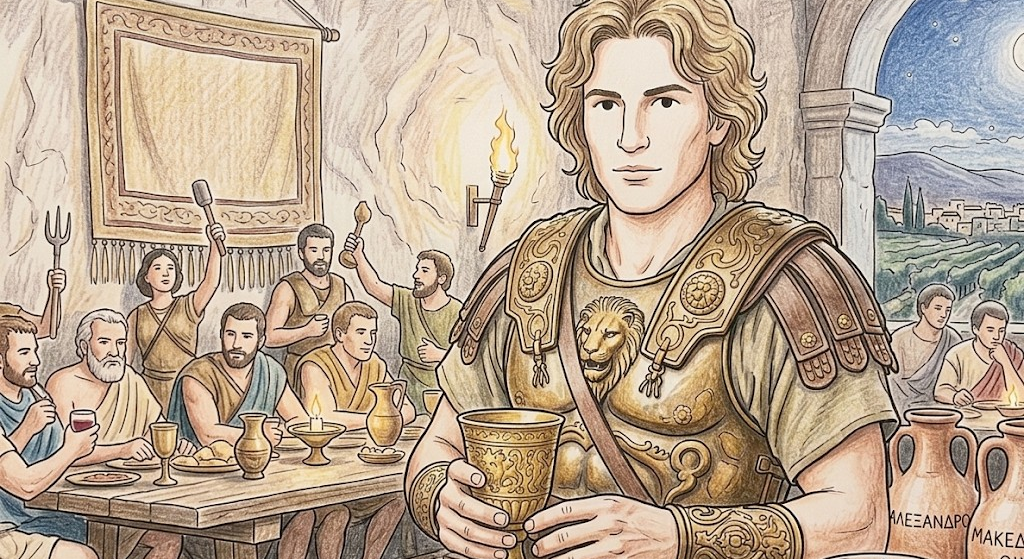
June 323 BC, Babylon. Alexander drained an undiluted draught from the so-called Cup of Heracles at a banquet hosted by his friend Medius. Within hours came searing pain “as if speared in the back,” fever, and death at thirty-two, the hero’s tale turns, at the end, into a medical mystery.
To read that final cup, go back to an older war over how to drink. In Athens and the southern poleis, mixing wine with water was civilization itself. Drinking straight, akratos, was the mark of a barbarian who had abandoned reason.
Macedon reversed the code. Emptying unmixed wine proved nobility and courage. Philip II was notorious for deep drinking; drunk at table, he and the young Alexander are said to have drawn swords on each other more than once. For the king, the cup was also a stage for fear and defiance of his father.
Following Dionysus east
Olympias, his mother, came from a region steeped in the cult of Dionysus, the god of ecstasy and wine. Alexander is said to have believed he carried that god’s blood.
In myth. Dionysus marched east to India and spread the vine. Scholars see his real march, through Persia toward the Indus, as partly a religious romance: to walk, and surpass, the path of an ancestor.
Wine here was less a pleasure than proof of divinity. His armies planted Greek colonies and vine cuttings from home. That line is often traced forward toward the Silk Road and the spread of grapes in Asia.
Cleitus, the night wine took reason
328 BC, a camp in Sogdiana, modern Uzbekistan. Alexander, drenched in strong unmixed wine, quarreled with Cleitus, a companion who had saved his life at the Granicus and served since Philip’s day.
Drunk, he seized a guard’s spear and ran it through Cleitus’s chest. Court diaries preserve the night in grim detail.
When sober, he is said to have shut himself away for three days, refusing food, wailing at what he had done. After his greatest victories, the cup had taken his closest friend, the human heart of the story.
The contest that killed forty-one
Around 325 BC, returning from India. When the philosopher Calanus died, Alexander held a memorial contest: who could drink the most unmixed wine.
Promachus, the winner, is said to have swallowed some thirteen liters of pure wine, and died of alcohol poisoning three days later. Ancient sources claim thirty-five men died the same day, forty-one within days (figures debated among historians).
A funeral toast became one of history’s deadliest banquets. The shared cup that bound an empire could also count bodies, the shadow side of Macedonian akratos.
Vines to Gandhara
The march left marks on wine and art. Greek planting in oasis towns such as the Ferghana valley is sometimes linked, in later tradition, to Zhang Qian bringing grapes back to Han China.
Hellenistic fusion produced Gandhāran Buddhist art. Reliefs show grapevines, fruit, cups, scenes that echo Dionysian revelry.
Alexander’s cup outlived him in altered form. Conquest memory survives at the edge of a Buddha, as clusters on stone.
The last supper, poison in the cup?
Back to Babylon. For years malaria or acute alcohol poisoning led the theories. Recent work, including a 2014 toxicology study, has revived talk of poison, perhaps hellebore used to flavor or medicate wine.
The truth is unsettled. What is clear is that his life was bound to unmixed wine, sacrament, weapon of empire, and trigger of tragedy. At the end, the cup may have consumed the king who raised it.
The glass in your hand today
Fourth-century Greek wine is not what we pour today. Yet the split, diluted reason in the south, straight akratos in the north, shaped part of the culture that followed.
Assyrtiko from Santorini, Xinomavro from Naoussa, Agiorgitiko from Nemea: modern Greece still carries lineages spun after Hellenism. Volcanic whites, inland tannins, Peloponnesian reds, each holds terroir beyond the old debate of mix or no mix.
When you tilt a Greek glass, you may taste the echo of Dionysus’s eastern road, and an empire one king built and broke with the same cup. After myth and tragedy, a drinkable history remains.